
Sharon Stone Was Almost Murdered, And Protected Her Assailant: Grew Up Beaten, But Credits Her Father With Making Her Who She Became—A Rare And Riveting Interview About Family, Valor, Violence & Love
Picking Up On Our Theme Of "Fawning," Its Purpose, And Its Consequences

“Only you know who you are.”
—Sharon Stone
Sharon Stone’s unequivocal message in this new viral interview seems so very of this moment, if “this moment” is being experienced by others as I am experiencing it.
The “moment” when you finally stop, as we discussed here, a few days ago, fawning for survival.
The moment when nobody’s arrows, attacks, tantrums, or attempts to subvert your sense of yourself, work on you like they always did before. No matter how close to you they are, no matter the cost of spiritually walking away.
Or…is it just me?
”There
will
be
many
people
that
will
try
to
tell
you
who
you
are.”
Guess what they will all be?
Wrong.
As we ourselves will be wrong, each time to attempt this undermining cr*p against anybody else.
Clip here. (Image is below—clip is here to the left, in red.)
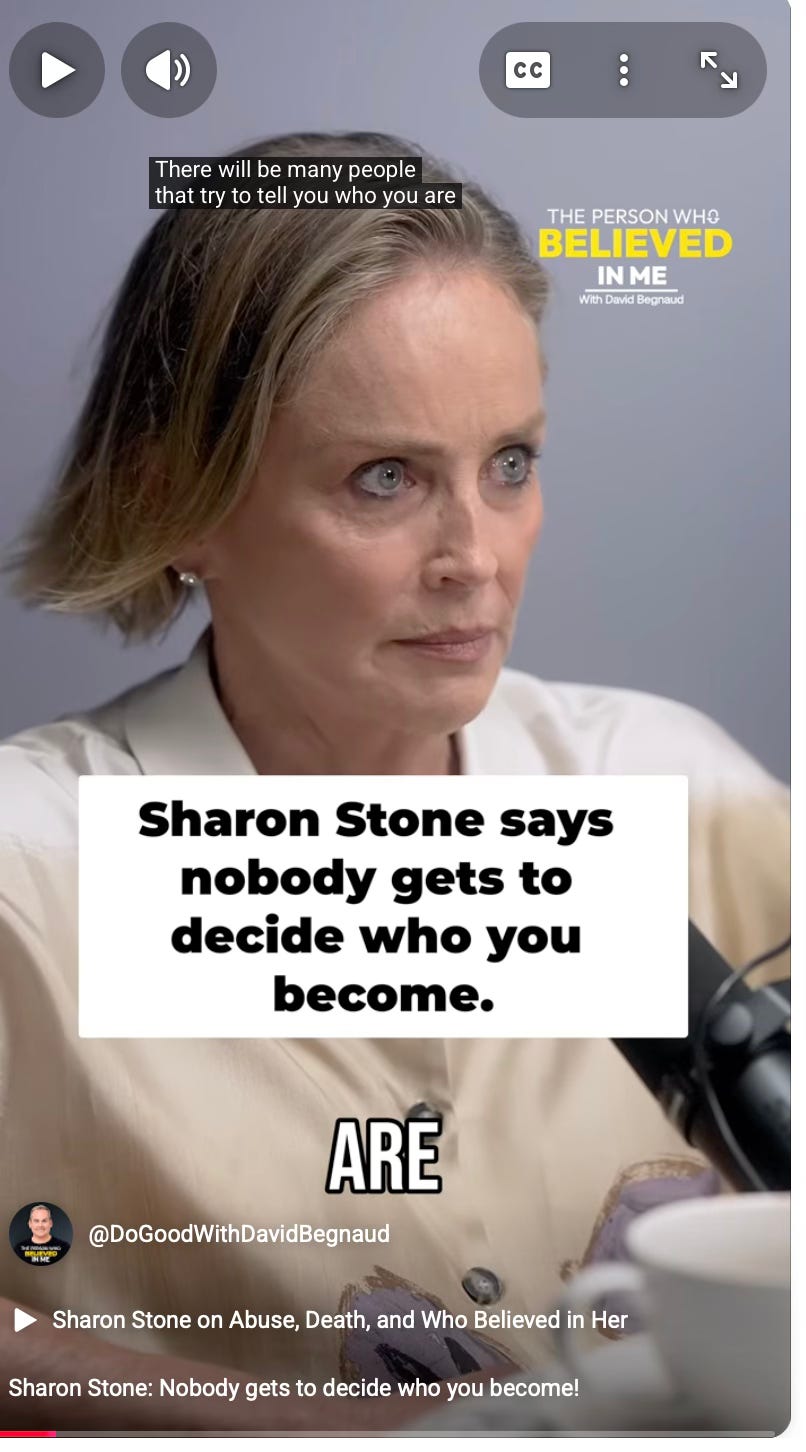
Here’s the full interview:
I’m not a movie person, at all.
I don’t have favorite actors or actresses. I can barely stand sitting through movies, and almost never do. (I wish to improve.)
Now all of a sudden I want to take the trouble (though I am unlikely to find the time) to watch some of Sharon Stone’s movies, for how riveting I found this interview she did with somebody named David Begnaud. He’s built a podcast around the concept of people talking about who believed in them the most.
Who Was It?
For Sharon Stone, it was the same man who beat her up regularly as a child, threw her down stairs, whipped her with a belt, and made sure she didn’t fold herself in to fit in, to be liked, made sure she didn’t let boys win games, to be liked by them, made sure she understood her “power—” which was a kind of hardscrabble rural Pennsylvania brand of power. His kind.
It was her father, who encompassed all of these contradictions: John Stone lll was his name.
(I love people who understand and can think in terms of contradictions and incongruence.)
Once, at age 14, when Sharon was called downstairs by him, to get another beating, she descended the steps very slowly, she describes, “like the queen of France,” and got this close to his face. She asked if he needed to beat her up again to prove that he was a man, and if so, that he should get on with it, but be aware: “I will never love you again.”
He broke down crying. She was not beaten—none of the kids were ever beaten again.
This makes so much “sense” to me—it’s going to be the same person, that person. The person who threw you down the stairs will be the same person who taught you to fight tooth and nail, not to be diminished.
It’s truly rare and to my ear brilliant conversation—which I say as somebody with extremely negative feelings about Hollywood and everybody in it. I hope people do not beat me up in the comment section for writing about a Hollywood person—that is of course not what interests us. It’s the universal themes, actually.
To the extent I have ever been aware of Sharon Stone, I was perhaps vaguely aware she was taking all kinds of punishments for, some might say, her beauty—but I think it was more a matter of her father’s imprinted defiance. That and her extremely dangerous intuition, which she discusses.
It becomes clear in the interview that somebody she was not “at liberty” to name, clearly a famous ex husband, came very close to killing her, in such a way she only understood what had happened 10 years after the fact.
Sharon Stone really illuminates the double helix of women such as herself (known as “sex symbols”) being worshipped as the part of the helix that promises, in equal measure, murderous hate and extreme violence. Likely death.
In her life, which is full of jaw-dropping stories, she has enacted, survived, and lived out that whole double helix like few, or almost none.
What I love about her is that she does not lie. She does not soften, dissemble, take easy streets, or reach for adorable cliches when discussing her life.
She can hold up hard glass to the sun and see both its edges and its luminosity.
It’s hard for me to write about this kind of thing because I do not want feminist-ey seaweed around my wrists when I need to begin to attempt to write about how life is for women, as compared to how it is for men. For me this is the forbidden subject in a locked vault under the sea floor.
Why?
Because women have to conceal everything, carry it, hide it, keep it all in that vault under the sea floor.
Sharon Stone still can’t bring herself to name her near-murderer, though she was compelled by doctors to press criminal charges 10 year after the fact.
Let that be a beginning—the beginning of an understanding—for how far women will go to “spare,” a given man, his abhorrent, even criminal conduct.
Why?
To spare the whole.
The whole system, each spike and gear of which she, as a woman, intuits and/or knows by heart, from this life, a past life, her mother’s life, her mother’s past life or all of the above.
Downton Abbey actually—of all programs— gets this pitch perfect right: When Anna is raped, she conceals it, from all, and from her husband, even as it begins to destroy them both, and their marriage. She won’t speak it.
Men will wonder:
“But why?”
Women will not wonder.
Women do this to spare the whole of the fabric, to save the ship, keep the system running. A self-immolating behavior which begins and ends with her knowing how much destruction she will unleash, and be blamed and scapegoated for, if she dares tell it.
So, finally, somebody got the subject of rape right. Anna knows that if she tells what happened to her, her husband will be hanged, for he will (being an intact man) go kill the guy.
That’s part of the rape dynamic that is almost never handled correctly.
Double Helix: Worship Is The Same As Hate
Sharon Stone: Titanic and mythic, a “goddess;” Also— barely permitted to live.
That’s the “double helix.”
How many screen goddesses can any of us name who were not savagely beaten by their husbands?
(And I also want to make a special request that we avoid the fight about “DNA,” since I’m only using the helix as a visual aid.)
I might listen to this podcast a second time—it was so interesting.
I have always been envious of women who had fathers, strong fathers, fathers who believed in them, or fathers of any stripe at all, actually in an actual house with them growing up. But more than envious, I’m fascinated.
A commenter wrote:
“Sharon says she was never made self-conscious about her intuition and being overt about her abilities, speaks volumes about the conditioning most of us receive. Her self-assuredness is the way each of us would be without the dimming behaviour that her father didn’t allow. She brings attention to the gender bias that exists around the world and how strong, intelligent women are treated. While her story may appear complex, what if we change the lens through which we are looking? I love how Sharon turned your usual question into an opportunity to share her spiritual wisdom in a manner that is an opportunity to speak to each of us, if we are willing to slow down and take it in. Thank you again for a beautiful and important conversation that causes us to pause and ask ourselves, what meaning does this have for me?”
I know her story is compelling, especially to those who it rings close to their own lived experience, resonating at a deep level, even soothing, healing, someone else who understands and gets the shared trauma.
BUT...I also know that Sharon Stone is a professional actress. And a very good one, to put it mildly. A top of her profession actress. In Hollywood performers often will lean into controversial subjects, reveal sympathetic life arc's and whatnot for the PR they calculate to drive attention to their work...that they are paid for and have legacies they wish to build and leave behind. Any attention being good attention and all.
To completely surrender over to her interview and say 100% she doesn't lie is a stretch for me. She has said many things over the course of her public life that are opportunistic to advance her career.
I do not know if that is the case in the interview you are highlighting. But no one but Sharon Stone herself and the person's she names know if she is lying. Nobody else, no matter how much we want to believe it, who we can see ourselves in her shoes and appreciate that she's telling her story, laud her bravery.
I'm old enough to remember when Duke Lacrosse team members were destroyed by allegations of racist, sexist abuse. And when the allegations were revealed to be lies the accuser was still lauded because her accusations alone resonated with many who wanted to believe her and said they didn't care that she made it all up, that the controversy and trial of the team members "raised awareness" and therefore served a greater good.
I appreciate the sentiment you are conveying, the truths you carry, and the truths that Stone *may* also carry. But I won't suspend my judgement of her credibility because of an assertion that she doesn't lie. It's logical to be leery of any and everything that skilled professional actors say. Just sayin'.
Celia, you may not be aware, but Substack rolled out a new AI comment moderator and is hiding comments automatically. Per Alex Berenson, you should be able to turn it off on your end. Just an FYI because I see it is hiding things here.